Models have been agreeing on a small system moving through the area Wednesday afternoon. As of right now, the snow showers should start sometime after midday and continue into the late afternoon before tapering off. Because the snow will fall during the day, roads will be wet and the snow will only accumulate on grassy surfaces. I am calling for at most an inch of snow on the grass by Wednesday evening. Once again, nothing to worry about.
NAM Feb 8th Snow
In the longer range, the prospects for snow have been looking extremely promising. Next week will be cold and dry. The setup will not be favorable for rainy/snowy days. But…. the forecast models, as well as the telecommunications, have been showing a stormier setup the week after Presidents Day weekend. The cold air will be in place; all we need is a buckle in the jet, favorable high positioning, and a storm for snow.
I know it has been an extremely disappointing winter for the “snow-geese”. Personally, I was looking forward for some fun in the snow my senior year of high school (as well as some snow days). But, some things do not work out. Many meteorologists have been on their heels this winter, including me. Many storms have not turned out to be as expected, and the cold air just hasn’t shown up for the party. Late February and March will hopefully be an exciting end to the 2011-2012 winter.
I am introducing a new feature to Philaburbia Weather called Fun Fact Friday. Every Friday, I will introduce an interesting and amazing weather fact.
This week, I want to elaborate a little on the frozen Niagara Falls in 1932. The falls froze twenty years earlier in 1911, but no picture evidence exists. In 1932, however, the falls froze completely over again after a brutal cold stretch. One almost surreal picture remains of the frozen falls. Enjoy.
Sorry for the lack of posts everyone, as I have been sick with a cold/sinus infection. The past week has been very tough for any snow lover. Temperatures reached into the 50s and even 60 last week, with rain and clouds dominating the landscape. Our pattern has become fairly active, and we will continue to see small systems move through this week. Temperatures should start out mild this week, with some uncertainty heading into Friday. Thursday night into Friday morning, a possible storm could affect the region with some rain or snow. Stay tuned.
Teleconnection Update:
As I have explained in previous posts, the teleconnections are key to see if a cold and snowy pattern will return by the end of winter. The NAO, AO, PNA, and MJO are just a few of the important teleconnections used by many meteorologists to determine future trends.
The NAO has been positive all winter. This teleconnection has been a reason why we have not seen many strong coastal storms and colder weather this winter. At this point, it looks like the NAO becomes negative for 2-4 days (February 4-8th)before turning positive again. This should mean we will see more of the same in terms of storm track through mid February. But there are other factors… (see next paragraph)
NAO Feb 2012
The AO (Arctic Oscillation) is a teleconnection used by any credible forecaster to determine whether the upcoming pattern will be a snowy one or not. The NAO and the AO are very similar teleconnections and are known to affect each others indexes. The AO measures the temperature anomalies of the waters in the arctic circle. When the AO is negative, expect snowy conditions with some brutal cold air. Our snow outbreak of 2010 involved a record negative AO. 9 out of 10 coldest Januarys in NYC have been correlated with an extremely negative AO. This winter, the AO has been extremely positive, explaining the above average warmth we have had so far. But recently, the AO have been substantially negative and will continue to over the next two weeks. This is where a conflict comes in. The NAO is expected to move positive, but the AO will be negative. What will happen? I look toward the PNA and MJO, the two other important teleconnections, for more answers.
AO Feb 2012
The last teleconnection I will overview is the PNA. The PNA (Pacific North American teleconnection pattern) measures the relation between the atmospheric circulation between the North Pacific and North America. A positive PNA usually means below average temperatures for the east coast, while negative values means above average temperatures for the east coast. This winter, the PNA has been neutral and has not been much of a factor. The PNA is expected to go slightly positive over the next two weeks.
All three of these teleconnections need to be favorable (negative NAO, negative AO, positive PNA) for the eastern seaboard to receive a major snowstorm. The last two winters the teleconnections were perfect for snowstorms. The NAO and AO were safely negative, while the PNA stayed positive. Right now, the NAO is the only teleconnection that is not in a favorable position. It is expected to go slightly negative around the 4th-8th. This time period is when I am expecting a possible snowstorm to affect the region. This winter has been frustrating. Even though our weather has been rainy and warm with some spurts of cold weather, I expect one major storm to affect the region by the end of February. Most of the stones are in place, and it is only a matter of time until the keystone fits.
Every major computer model is in consensus on a storm affecting our area late tonight into Saturday afternoon. The National Weather Service has issued a Winter Weather Advisory for the whole area until 5 PM Saturday. Currently the storm is streaking across the midwest, dropping a few inches of snow on Chicago and Indianapolis. By late tonight the first snow flakes will fall in the Western areas of our region. By early Saturday, most areas will be in the thick of the storm. By late morning, warm air aloft will change the snow to mix around the city and dangerous freezing rain in the NW suburbs.
Here is the overview,
Timeframe:
Snow arrives 11 PM-2 AM west to east.
Moderate snow 2 AM-6 AM
Heaviest snow 6 AM-10 AM (mixing with rain in South Jersey and Philadelphia)
Snow changing to ice north and west: 10 AM-2 PM Saturday
Snow ends: 2 PM-6 PM Saturday
Effects:
Roads will become very slick Saturday morning as the snow will change to freezing rain. StateDOT crews have put salt on the roads and it should be effective to an extent. One current observation I have are about the current temperatures around the region. At my house the temperature is 25 degrees, much warmer than what the computer models were projecting for this timeframe. I am worried that areas north and west of the city could receive a substantial amount of freezing rain as the surface temperatures stay below freezing, while the air aloft climbs above freezing tomorrow. Roads will be in bad shape into the afternoon and I do not recommend going out into this mess. Just stay home, have a hot cup of tea under a blanket, and read a good book.
Amounts:
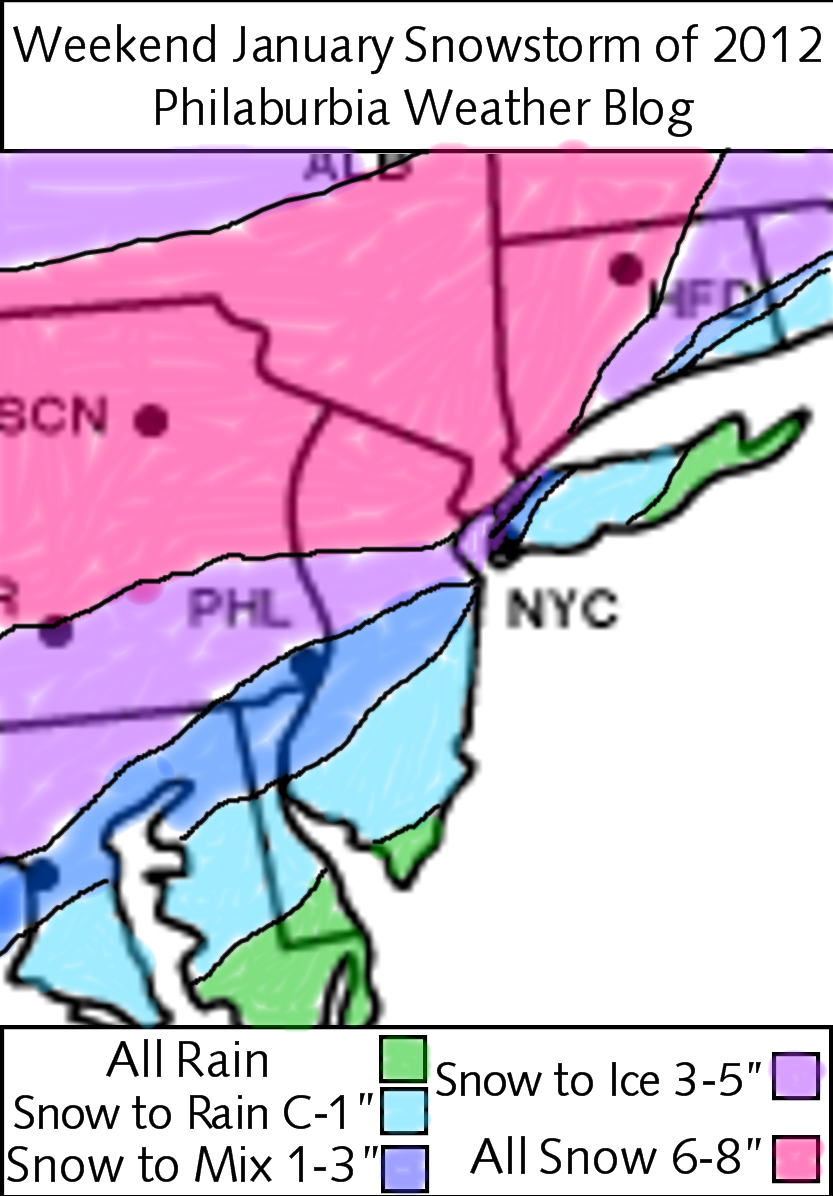
At the Jersey shore, primarily rain will fall as temperatures will stay above freezing. South Jersey should have a quick change to rain after a coating to an inch of snow. Areas around the city should have an eventual change to rain after 1-3 inches of snow. The north and west suburbs should have 3-5 inches of snow falling before changing to some freezing rain. Ice accumulations possible in this area. In the Lehigh Valley and north, all snow is expected: 6-8 inches.
The feeling of snow is in the air as our first really snowstorm of the winter will arrive Saturday. After many models were showing a rain/mix storm a few days ago, they are now trending toward a mostly snow solution. What does this mean? Well, it means that we could receive 2-4 inches of the white stuff by Saturday night. A Winter Weather Advisory will likely be issued. I know many schoolchildren will not be happy about snow on the weekend, but I would be grateful we are seeing any at all. Just be patient.
Here is the NAM model at 7 AM Saturday showing moderate snow falling:
Snowy Day on Saturday
Because this storm is a last-minute forecast, I hope the stateDOTs salt the roads by Saturday morning. The roads will be pretty treacherous throughout the day on Saturday if they are not treated. I would not recommend even driving on the roads at all Saturday morning into the afternoon. If you have to drive, then do what you have to do… just be careful and aware.
Timeframe:
The snow should start early Saturday morning and last into the late afternoon before moving out. Mixing will occur in places south of the city. The north and west burbs’ should see mainly snow with maybe some sleet mixed in at times. I will post updates if anything changes with this storm over the next 24 hours.
My snow map will be released tomorrow along with other details.
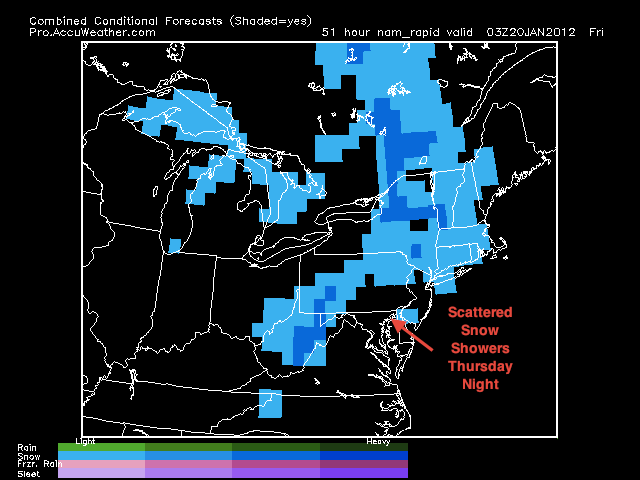
Temperatures are currently in the 50s in many places around the region. This will not last long, as a cold front approaching from the west will cool us down. Temperatures will be in the upper 30s until the end of the week. On Thursday Night, there is a chance for a few scattered snow showers to fall. They will not accumulate too much, but will be localized. As a result, the Friday morning commute in some places could be a little dicey.
Here is the NAM for 10 PM Thursday:
NAM 10 PM Thursday
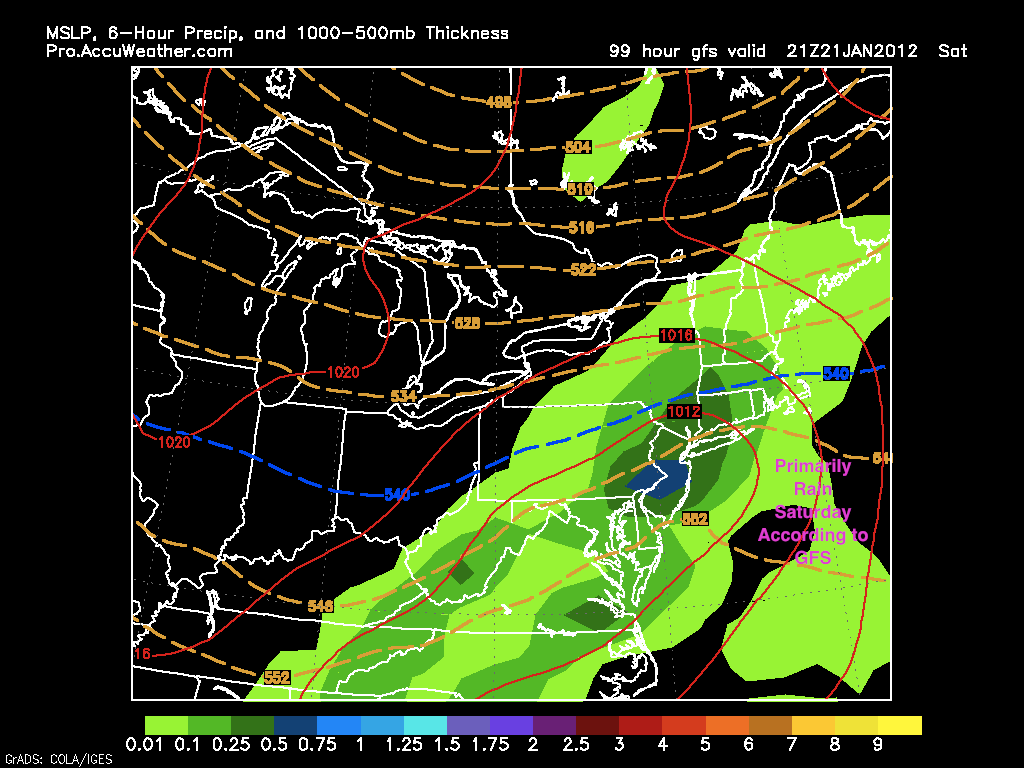
A storm system will affect the area Friday Night into Saturday. This storm will be riding a primarily flat jet, and will not strengthen into a major nor’easter. Like most of the storms this winter, the question that remains is how much cold air will be available during the storm. The European shows some snow (1-3 inches) for the area Saturday Morning. The GFS, however, is warmer aloft and keeps the precip as primarily rain. Right now, I am leaning toward the GFS solution. The NAO is going positive (again), and the cold air just won’t be in abundance. I’m sorry to say it, but this winter so far has been about the lack of cold air aloft.
Here is the GFS showing a primarily rainy solution Saturday:
GFS solution Saturday
There is some good news, however. The NAO is projected to sink by the end of January, and the AO (Arctic Oscillation) will also be negative. Both of these teleconnections being negative are good signs for an active February. Next week there is a chance of another storm, but rain is looking to be the primary precipitation.
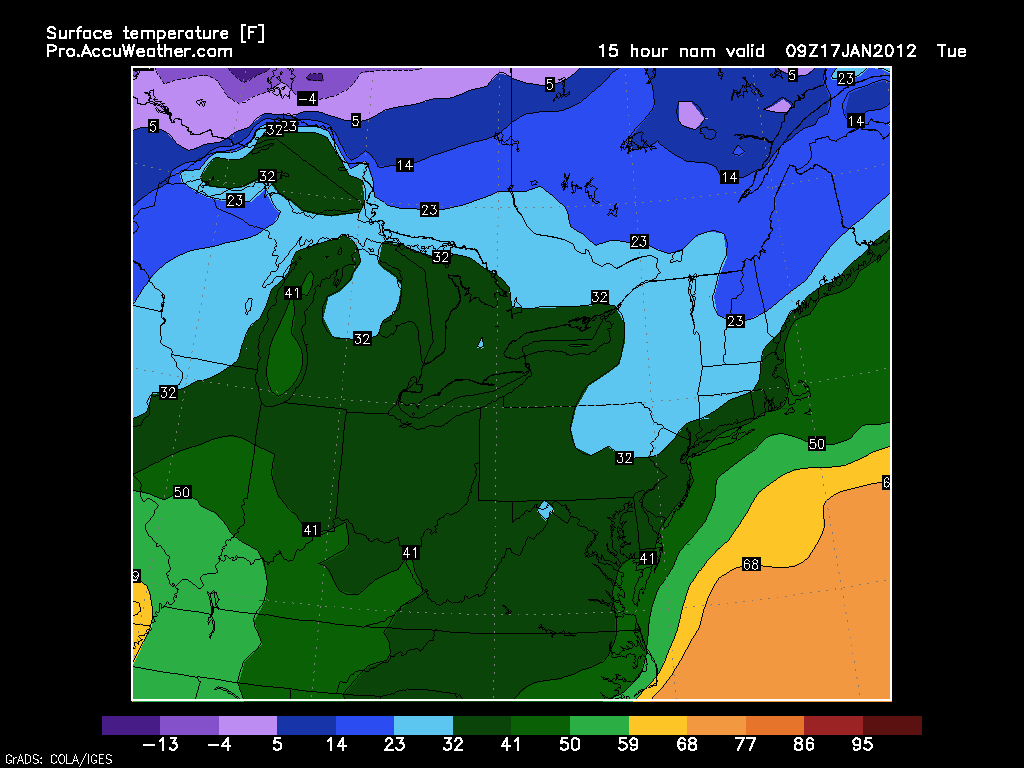
Temperatures could stay below freezing in the Lehigh Valley and northern Bucks County tonight as a storm system affects the area. Because upper air temperatures will be above 32 degrees, freezing rain will be the main concern from this storm. The question that remains is where will the surface freezing line be tonight? According to the GFS model, the 32 degree line may reach as far south as Quakertown. As a result, the National Weather Service has issued a Winter Weather Advisory much of New York, the Lehigh Valley, and Bucks County.
Surface Temps 4 AM Tuesday
Ice accumulations won’t be major, but could make for an interesting morning commute for people driving to work in the advisory area. Most of the Philadelphia region will be above freezing and could see around a 1/2 inch of rain by Wednesday night.
In other news: Temperatures next week could be in the 50s. The La Niña is still hanging on, and “ol’ man winter” has yet to show his face. Not a great winter for the snow geese.
Heavy rains are moving north as a strong low pressure system moves northward. The I-95 corridor is on the warm side of this storm, and temperatures could reach 60 tomorrow. As the storm pulls away, a “flash freeze” could occur. Temperatures will plummet drastically and swiftly. By late Thursday, temperatures will be near freezing as a secondary low moves in. Snow is a definite possibility from this weaker system as there will be plenty cold air aloft. Totals will not be high. At most an inch of snow could fall on grassy surfaces by Friday morning.
Some Snow Friday Morning
Winter continues uneventfully this weekend with sunny skies and frigid temperatures. Our next system to watch is for next Wednesday and Thursday (18th-19th). Right now the teleconnections and models are not favoring a major storm with snow.
Many people have been asking me about the lack of snow this winter. The La Niña (Eastern-Central Pacific ocean temperature anomaly) turned out to be much, much stronger than I originally anticipated during the Fall. Right now, there have been signs that the La Niña is weakening and maybe even changing to an El Niño. Our weather for the next few weeks will reflect a similar pattern to what we have had this winter. But, I believe that February will bring a major change. I could be wrong, I could be right. That is the amazing part about the weather: anything could happen at anytime. Stay tuned as winter continues.
After our extremely warm weekend, cooler temperatures will continue until Thursday. Tomorrow night there is a possibility of some snow showers to fall, which may put down a quick inch of snow on grassy surfaces. Nothing major, but it is something…. By Thursday morning, a strong low pressure system will come northeast and hug the coast. A good 1-2 inches of rain could fall from this system before a cold front brings in the arctic air behind it. Next weekend, temperatures will be in the 30s and lows in the teens.
Next week, in my opinion, is the start of the winter pattern. It will be more stormy. It will be cold. February will be the month where we have the best chance of a major snowstorm. Right now our next chance of some snow is January 19th-21st. There has been some model guidance showing a storm hooking up with the cold air and phasing with the jet during this time period. This 19th-21st storm will be the sign whether there’s a pattern change actually occurring.
About the weakening La Niña:
There have been a few signs that the La Niña, which has contributed to our warm winter, will weaken. The SOI, a common telecommunication used to measure La Niña/El Niño strength, has been going negative. This means that the Niña is weakening. For the first part of this winter, the SOI values have been extremely positive signifying a strong La Niña. But over the past week, it has gone neutral to negative, which may signify the El Niño taking over. If this is the case, history supports a brutal February and March. Snowstorms and record low temperatures into early spring would be expected if the SOI is accurate. Right now, I am not sure if we are seeing a major change in pattern. The SOI could go positive again, meaning we are back to the warm and rainy winter. I will continue to monitor the SOI over the next few weeks.
Snow showers associated with a weak clipper system will pass through the area today. Many people could see some light snow fall by the evening, a taste of a much-anticipated winter. The snow should not stick, even on grassy surfaces. Another clipper will pass to the north of us New Years Eve, giving us a similar scenario as today. Arctic air will invade the region on the 2nd after a weak cold front passes through the area (with more snow showers).
Tuesday and Wednesday will be very very cold. Low temperatures could go into the single digits in some places with highs not even getting out of the 20s. This will be our first real arctic freeze of the season. By Friday, a storm system will head out to sea and bring back some warmer air. The temperatures should remain in the low 40s and upper 30s into next weekend and beyond.






 Philaburbia Weather Blog