Extremely hot temperatures plagued the area this past weekend as records were broken on Friday, Saturday, and Sunday in the area. These temperatures will probably be the hottest of the year and even for years to come. Philadelphia hit 105 degrees on Friday. This was just one degree shy of their all time high of 106 degrees.
For the next few days, look for the heat to subside as the Bermuda high moves out. The heat will return later in the week as the Bermuda high will move back in and bring back the southern air.
Heat Wave Stats
Tropics:
Tropics have been fairly quiet right now. There is one invest that is worth noting in the Caribbean. If this disturbance were to organize into a tropical system, it would head into Southern Texas/Mexico as a hurricane.
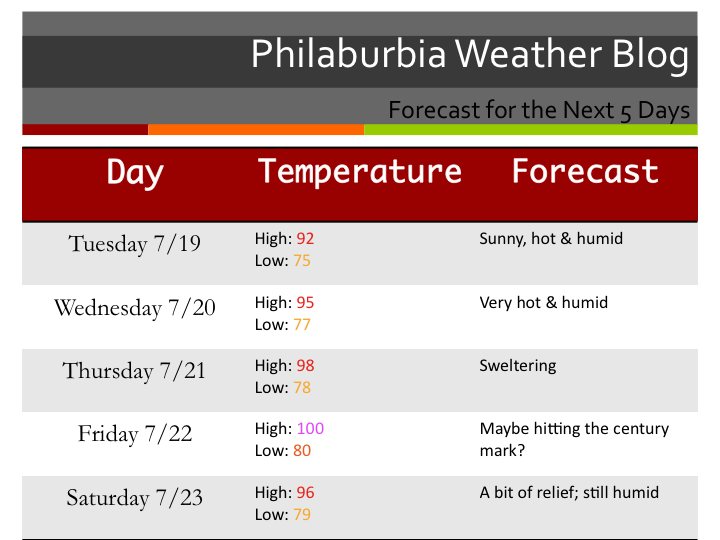
It is going to get very hot later this week as a powerful high pressure set up in the Midwest will bring in warm and humid southern air. Temperatures will be in the upper 90s or maybe even 100 degrees later this week. There is no rain in sight after tonight (some nasty storms could pass through the area tonight), so plants and trees could start to show signs of wilting by next weekend.
Forecast
I also wanted to talk a little about the tropics, as it is starting to heat up. We have Tropical Storm Bret out in the Atlantic right now. It shouldn’t be any threat to land, other than the Bahamas. There have been signs of late that another storm will form next week… details are vague at the moment. As of right now, it is looking like an active hurricane season coming up this year.
Hi everyone. Well we have another day with severe storms in the forecast. The last few days have had more isolated storms, but today a more widespread event is expected. A frontal boundary associated with a low pressure system is expected to pass through our region later today. Combine the ultra high dew-points with the instability from the front, and we get some fairly nasty storms. Right now there is a flash flood watch for the area because of the slow movement of the storms. Two inches of rain could fall in less than an hour for some of these storms! Expect more storms to pop up and intensify as we head into the late afternoon.
Tomorrow should be much nicer then today as we finally get some relief from the hot and humid weather.
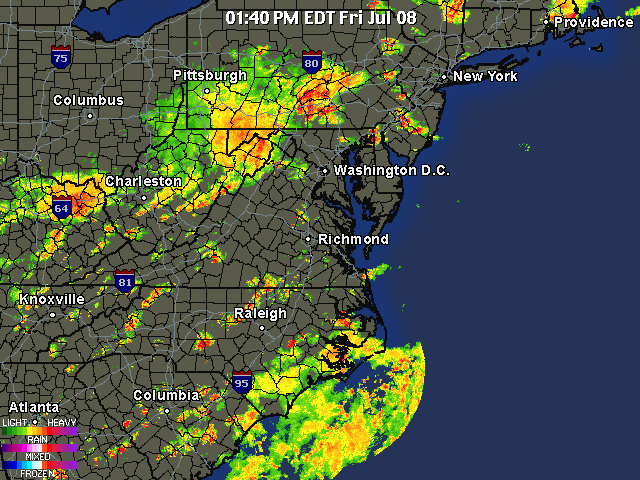
Here is the radar as of 1:40 PM. For continuous radar updates, check out the radar tab at the top of the site.
I am becoming more and more concerned and worried about the latest ocean temperatures for the majority of the east coast and Atlantic Ocean. I have had fellow blogger Brett Wiley introduce me to this startling observation, and as well have read about it on some other blogs as well. According to NOAA, the ocean temperatures off the east coast are well above normal. Water temperatures are currently in the mid 70s along the Jersey coast and continue to be above normal all the way down to Florida. As many people know, we are heading into the peak hurricane time-period in a month or so. Hurricanes thrive over warm ocean temperatures, part of the reason why most of them reach their strength in the Caribbean or in the Gulf of Mexico (where water temps are in the 80s and 90s). Usually by the time the hurricane reaches the cooler waters around our area, it weakens substantially and speeds up in the process.
Here is the map of the temperature anomalies for the Atlantic Ocean. Green, yellow, orange, and red represent above average temps:
Anomalies for Atlantic Ocean
Atlantic Ocean temperatures peak in mid August and usually end up reaching the mid-upper 70s. If we are already experiencing temps in the mid 70s, and it’s only July, we could be having temperatures in the 80s by the time August comes around. This is what scares me. If my prediction comes true, then hurricanes may not weaken if they move into our area.
I will continue to monitor the situation in the Atlantic for the next few months. Stay tuned to Philaburbia Weather for the next few months.
Well, it’s late June and we have our first Tropical Storm of the season. Arlene is located in the Gulf of Mexico and will most likely slam the Mexican coast before dissipating over Mexico. It shouldn’t have any threat to the US mainland whatsoever. If any details change about Arlene, I will let you know. For right now, however, I wouldn’t start worrying about this one.
Arlene and Path
Here is the current radar image of Arlene. I wouldn’t expect her to get much more organized in the limited ocean space she currently has:
There were a few nasty thunderstorm cells that pulled through the area yesterday. One passed through Montgomery and Bucks counties, before eventually dissipating over New Jersey. The other storms passed through South Jersey, where one death was confirmed by the National Weather Service. Both of these storms created problems for residents in the Philadelphia area. There was one report of a house almost catching on fire from a lightning strike in Newtown, PA. In Hatboro, PA there were reports of multiple trees down, and in Ocean County, NJ, there were reports of power lines down.
The storms that hit yesterday, as I said in yesterdays post, were scattered. It will be a similar story today. Right now skies are cloudy in much of the area, but as the clouds burn off during the day, strong thunderstorms will pop up during the afternoon hours. These storms will look similar to the ones that hit yesterday. I would expect strong winds, hail, and some minor rotation where they hit.
UPDATE 3:15 PM Wednesday: There is a Severe Thunderstorm heading to Bucks and Mercer counties. Right now it is over Lansdale, Montgomery County. Expect it at Doylestown at 3:35 and Richboro at 3:50. It will be in NJ closer to 4:15. If you hear thunder, move indoors immediately!
After a fairly quiet week and a half, we are going back to the stormier pattern for the end of this week. A frontal boundary to our north has brought in an unstable air mass, which will harvest strong thunderstorms and some isolated super-cells for the next few days. These storms will be widespread, but scattered. Philadelphia may get 4 or 5 severe storms over the next few days, and Doylestown may get none. It really all depends on location. As I’ve said in previous posts, keep your eyes to the skies. If you see any dark clouds approaching, move inside and secure any outdoor furniture. These storms have the potential to cause a decent amount of damage where they hit.
Here is the simulated radar for later today. According to this model, parts of the area would be experiencing a severe thunderstorm (as shown by the yellow color over the Philadelphia area):
Sim Radar for 6/22
As of right now, there are two cells of concern that are approaching the area. One is in northern Montgomery, moving east. The other is just north of Baltimore, moving almost stationary. I expect that more storms will be flaring up as the day progresses, so I have posted a live radar on this post to keep people informed.
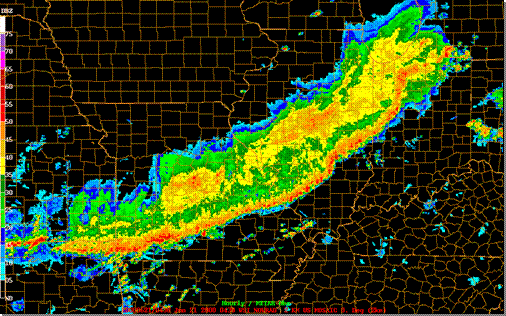
Temperatures are going up near 100 right now as the heat and humidity build in front of a major scuall line heading down from the Northwest. As of right now, there is a Severe Thunderstorm Watch for the area until 10 PM. There is currently a high risk of hail and high winds in excess of 70 mph.
Here is the current radar as of 3:45 PM
Thunderstorn Line
The squall line will reach the northern parts of the area at around 6 PM and move out of the region by 7-730 PM. Please keep a watch on the skies. If you see dark clouds, get inside immediately! These storms are extremely dangerous and will pack quite a punch where they hit. I will continue to update as the storms get closer
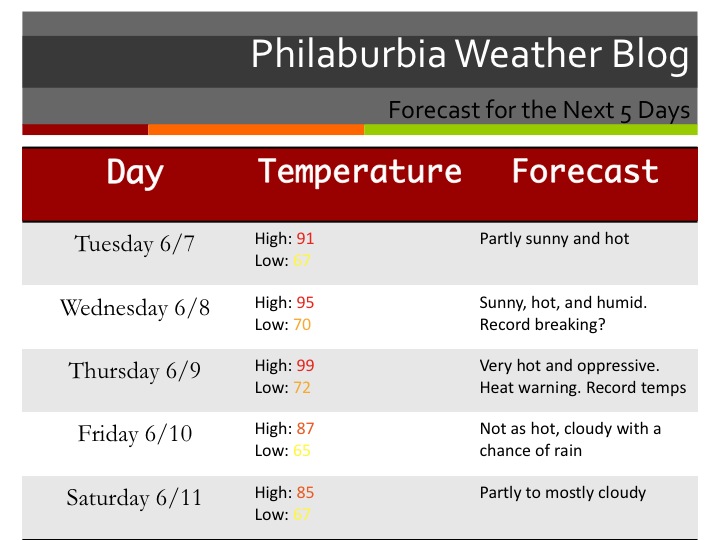
Heat Wave #2: It will be a bad one. After the last week of beautiful weather, it is only mother-nature-like to have a nasty heat wave right after. A very hot air-mass from Mexico will be moving into the area tomorrow, raising the temperatures into the low 90s. By Wednesday, the high could get to 95-96 degrees as the air-mass parks itself over the region. The hottest of the three days will undoubtedly be on Thursday, where the temperatures could reach 100 degrees! Truly amazing stuff for early June. There is an Excessive Heat Warning out for the area, as the air quality will be unpleasant to say the least.
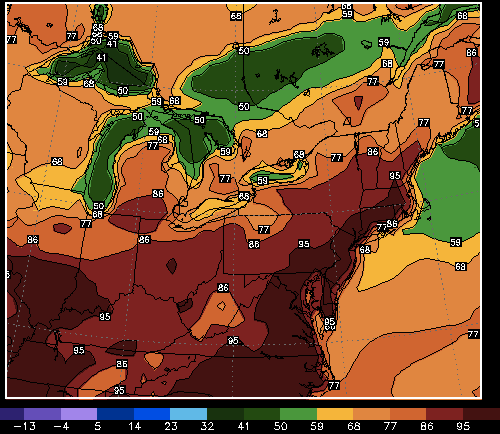
Here is the NAM’s predicted temperatures for Thursday afternoon. The scale only goes to 95 degrees, and it is showing temperatures hotter than that.
I figured it would be a good time to talk about cold fronts and how they contribute to our weather pattern.
Cold Fronts: So what are cold fronts exactly? Usually portrayed by a blue line with triangles pointing in the direction of travel, a cold front is cooler air replacing warmer air ahead of it. Cold fronts originate from a low pressure system and are always complimented by a warm front. This is shown in the graph below along with the process of the cooler air replacing the warmer air:
Cold Front Warm Front
Cold fronts are most common during the summer where they bring nasty thunderstorms. Here is an example of a classic summer day involving a cold front:
The morning starts out extremely humid as the warm front passes to the north. By noontime, temperatures are in the 80s and are approaching 90 fast. By the afternoon hours, the inevitable cold front is approaching fast with thunderstorms starting to build along it. By the 4 or 5 o’clock hour, the front passes through, bringing in nasty thunderstorms and gusty winds. By the nighttime hours, skies clear and the temperature is noticeably cooler. The next day should be a beauty!
The main reason why precipitation, especially thunderstorms, form along a cold front is because of the upward motion of the warmer air as the front barrels from west to east. The greater the upward motion, the warmer the temperature and the more unstable the atmosphere ahead of the front. This is why we get the most severe thunderstorms during the summer.





 Philaburbia Weather Blog